The mining research in Tunisia is fulfilled by an approach that is adapted to the geologic and gitological reality of the country. Indeed, Tunisia is a country which is essentially sedimentary and the vegetative coverage is weak, particularly in the country’s center and south regions for the reason that the dominant climate is arid and semi-arid except for the extreme north whereby it is temperate. As far as mining is concerned, Tunisia possesses above all deposits of the basic metals (Zn-Pb, Fe, Sr, Ba) which appear in the form of indices in several places in the country.
These climatic data, geologic and gitologic have contributed enormously to the research methods and tools.
Gitologic inventory :
This inventory consists of the reconnaissance and identification of the different mineral indications that exist in the country. This work is practically achieved; the NOM has fulfilled to identify more than 600 mineral indications which are considered to be subject of in-depth studies.
Geochemical exploration :
This mining-exploration method is widely used by the NOM. It consists firstly of “stream sediment” technique (alluvium wadi), followed by ground and rock geochemistry. The geochemical exploration is fulfilled in two scales. The first of which scales is strategic, whereby the sampling of “stream sediment” and is performed by a geological cut in 1/50000, and in a tactical scale (1/5000 to 1/2000) so as to study the strategic-geochemical anomalies and the mining prospects.
Geophysical exploration :
This exploration technique is widely used in the NOM. Several methods have been practiced: electricity, electromagnetic, magnetic, and gravimetric.
The electromagnetic and electric methods are mainly used in a punctual manner so that to sort out structural problems or verify the deep-rootedness of the geochemical anomaly, whereas the gravimetric and magnetic methods are used in the regional inventory. The ramble magnetism covers a large part of the country’s North West. Some regions at this level are covered with airborne magnetism, while the gravimetry covers approximately half of the country and is achieved, in the same manner as geochemistry, by a cut in 1/50000.
Synthesis works :
These works are executed by various thematic engineers from the NOM. The presence of 12 geologic and mining data bases, which cover the different NOM’s activities and ranging from geology to survey, have contributed largely in boosting this work.
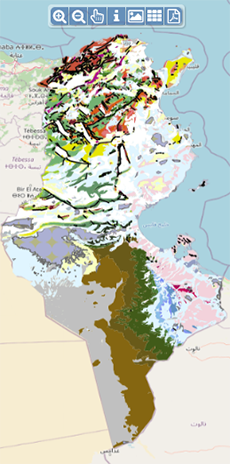
Decision-making maps have been produced, and hence have given way to new targets for the geologic- and mining-research works.
|