| Programme annuel & rapport de suivi technique |
-

Programmes Techniques 2026
-

Rapport d'activités 2024
|
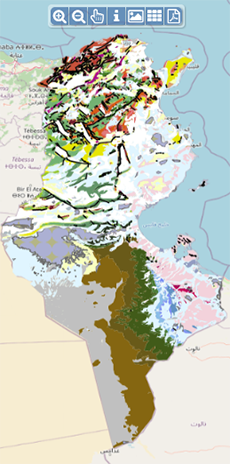
| Géocatalogue |
|
| Appels d'Offres |
-

DÉSIGNATION D'UN AVOCAT OU UN CABINET PROFESSIONNEL D’AVOCATS POUR REPRÉSENTER L'ONM
-

Annonce d'attribution Marché à procédure simplifiée AO01/2025
-

DESIGNATION D’UN REVISEUR COMPTABLE POUR LES EXERCICES 2025-2026-2027
|
|
Investir en Tunisie |


|
|
|
|
|
::
Documentation and Editions
>>
Research library
|
| |
|
[
Search by author
]
[
Search keyword
]
[
Search by index
]
[
Search by category
]
|
title of the reference :
|
Depositional history of southern Tunisia and northwestern Libya in Mid and Late Jurassic time.
|
|
Publication Date:
|
1985
|
|
Author :
|
Walley C.D.
|
|
Catalogue type :
|
Livre
|
|
Catalogue reference :
|
(3), T.122 (GBR) Geol. Mag. (3), T.122 Depositional history of southern Tunisia and northwestern Libya in Mid and Late Jurassic time. Evolution de la sédimentation dans le Sud de la Tunisie et le Nord-Ouest de la Libye au Jurassique moyen et supérieur. The good exposures of virtually underformed Callovian and Oxfordian strata along the Djeffara escarpment of southern Tunisia and northwestern Libya have allowed analysis of regional depositional history during this time. a number of lithostratigraphic problems are considered. In Tunisia, the Foum Tatahouine Formation is subdivided into members and in Libya some of the stratigraphic issues are clarified. A correlation between the two sequences is proposed. The widely claimed aeolian origin for the Libyan Chameau Mort Sandstone is rejected. The depositional patterns of the Callovian and Oxfordian strata are described in the context of Mid and Late Jurassic sedimentation in the eastern Ghadames basin of the African craton. After a regressive Bathonian sequence, transgressive conditions commenced in Early Callovian time. In a series of continental-marine cycles, this trasgressive sequence culminated in widespread shallow, restricted-marine micritic deposition. A regression in Late Callovian time resulted in emergence marked by a thin but widespread calcrete horizon. In Mid ? Oxfordian time a renewed transgression brought in open marine, high-energy, shallow-water carbonates. Later, regressive conditions returned, leading to increasing restriction, and latest Jurassic time saw the first signs of the fluvio-deltaic deposition that was to dominate the region in Early Cretaceous time. bibliogr. cycle sédimentaire ; sédimentation continentale ; sédimentation marine ; sédimentation déltaîque ; unité stratigraphique ; corrélation ; Jurassique moyen ; Jurassique supérieur ; formation Foum Tataouine ; Libye ; Tunisie ; Libye Nord Occidentale ; Tunisie Sud Orientale ; Jeffara ; Ksar Ouled Sultan Walley C.D. Roches Sédmentaires, Sédimentologie
|
|
Indexation decimale :
|
Roches Sédmentaires, Sédimentologie
|
|
Keywords :
|
cycle sédimentaire ; sédimentation continentale ; sédimentation marine ; sédimentation déltaîque ; unité stratigraphique ; corrélation ; Jurassique moyen ; Jurassique supérieur ; formation Foum Tataouine ; Libye ; Tunisie ; Libye Nord Occidentale ; Tunisie Sud Orientale ; Jeffara ; Ksar Ouled Sultan
|
|
Summary :
|
The good exposures of virtually underformed Callovian and Oxfordian strata along the Djeffara escarpment of southern Tunisia and northwestern Libya have allowed analysis of regional depositional history during this time. a number of lithostratigraphic problems are considered. In Tunisia, the Foum Tatahouine Formation is subdivided into members and in Libya some of the stratigraphic issues are clarified. A correlation between the two sequences is proposed. The widely claimed aeolian origin for the Libyan Chameau Mort Sandstone is rejected. The depositional patterns of the Callovian and Oxfordian strata are described in the context of Mid and Late Jurassic sedimentation in the eastern Ghadames basin of the African craton. After a regressive Bathonian sequence, transgressive conditions commenced in Early Callovian time. In a series of continental-marine cycles, this trasgressive sequence culminated in widespread shallow, restricted-marine micritic deposition. A regression in Late Callovian time resulted in emergence marked by a thin but widespread calcrete horizon. In Mid ? Oxfordian time a renewed transgression brought in open marine, high-energy, shallow-water carbonates. Later, regressive conditions returned, leading to increasing restriction, and latest Jurassic time saw the first signs of the fluvio-deltaic deposition that was to dominate the region in Early Cretaceous time.
|
|
Exemplaries :
|
TU1251A, TU1251B
|
|
|
|
|
|
|
|